
Many companies underestimate the foundations of digital transformation: without clear structures, streamlined processes and modern systems, business cases and ROI calculations often remain wishful thinking. Digitalisation is therefore not a one-off technology project, but requires a systematic approach, strategic direction and continuous investment, not least in people and organisation. The study results reveal an industry ‘in the making’ and ‘non finito’ as a call to consistently continue the effort.
“Non-Finito” is what the famous artist Michelangelo once said about his unfinished works. “Non-Finito” is also the prevailing sentiment regarding digital transformation in the Swiss real estate industry. Although this year’s Digital Real Estate Index (DRE-i) has risen slightly compared to last year, reaching 4.3 points, the real estate industry remains, according to the DRE-i’s stages of evolution, firmly rooted in the digital Stone Age.
Digitalisation is now, at least to some extent, a strategically rooted topic for the majority of companies, and the primary objectives – which often focus on increasing efficiency and optimising the business model – are clear. Yet the path to achieving this is by no means straightforward: in recent years, there has been significant investment, testing and implementation, but often without an overarching strategy. Instead of a digital foundation, new tools and specialist systems have emerged which, whilst tackling individual problems, are not coordinated with one another. Today, this seemingly haphazard patchwork is taking its toll and causing frustration in many places.
The Iceberg Effect
When asked about the obstacles to digital transformation, participants agree that investment and costs, as well as data availability, security and sovereignty, are at the top of the list of challenges. However, it is often realised (too) late just how many other challenges lie lurking beneath the surface.
Challenges such as legacy systems and integration, structures and processes, digital skills, corporate culture and strategic focus are only perceived subliminally (or not at all). It is particularly interesting that even the widely proclaimed skills shortage is not regarded as a real challenge. But if there is sufficient digital talent available, why has the level of digital maturity been stalling for years?
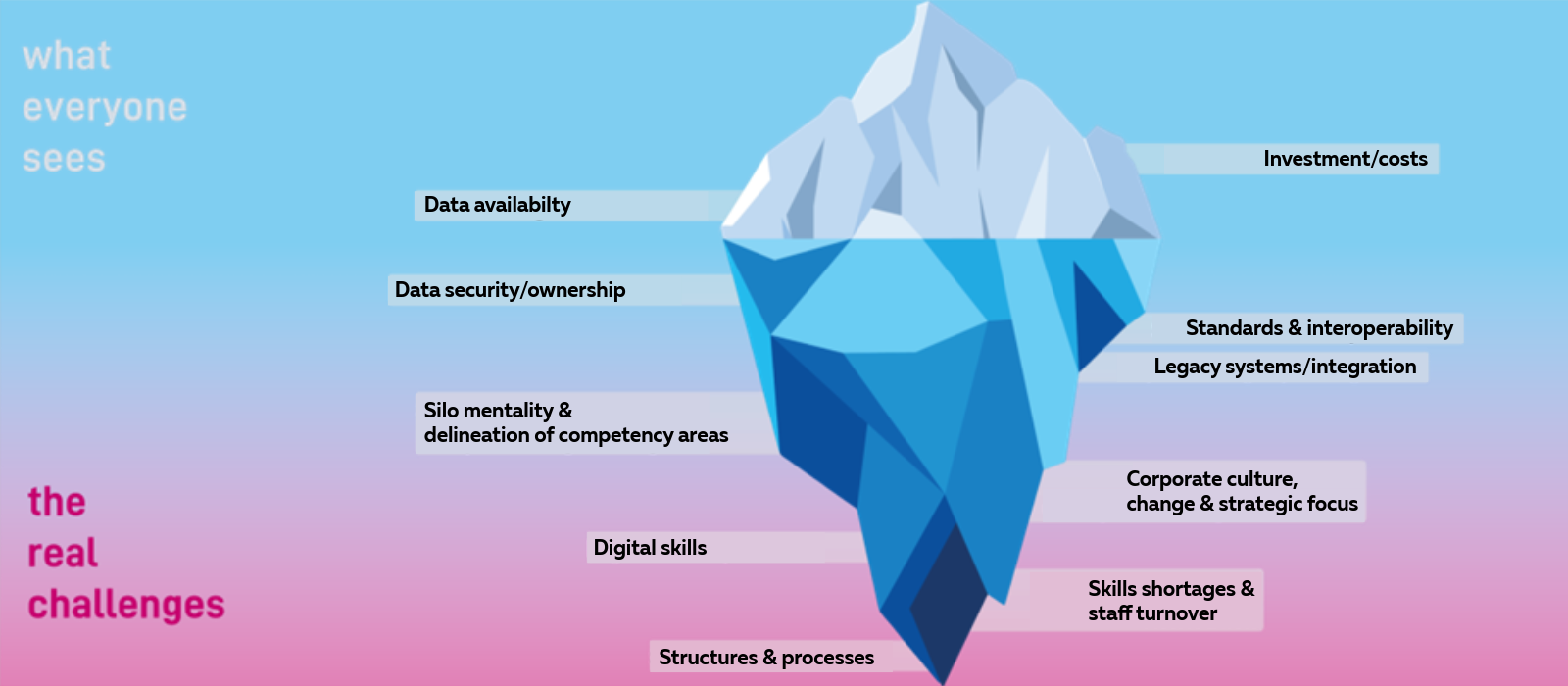
When transformation fails at the foundation
Our analysis suggests that many participants underestimate the importance of the digital infrastructure. Data and costs are undoubtedly key factors in any transformation. Yet without clear structures, streamlined processes and modern systems, every business case theory and every ROI calculation remains wishful thinking. This is because outdated technologies, in particular, hold organisations back. They cause high maintenance costs, complicate integrations and bind up resources. And even after a modernisation, these costs do not simply disappear.
Digitalisation is therefore no longer merely an innovation project, and certainly not just a question of technology. It demands a systematic approach, strategic focus and the realisation that transformation is not a state that can be achieved once and then ticked off the list. It requires a continuous engagement with changes in our environment and investment at all levels of the organisation.
However, we are still very far from this mindset, and we are not alone in this: an analysis by Deloitte shows that around 93% of all AI investment goes into technology, whilst only 7% is invested in structures and people…
Ultimately, the findings of our Digital Real Estate & Construction Study therefore point to a transformation that is still very much a work in progress. This is precisely where its true significance lies. It challenges the industry to act more consistently. Digitalisation cannot be treated as a chore or a mere cost burden. It demands commitment – both financial and psychological.
So let us take our cue from Michelangelo’s ‘Non-Finito’. It should remind us that incompleteness is not failure, but a state that compels us to continue working.