
Increasing regulatory requirements, organisational restructuring pressure and ambitious sustainability targets are making direct real estate investments ever more complex. Good governance can streamline decision-making processes, reduce risks and strengthen control mechanisms within real estate investment management (REIM).
Why governance determines performance today
Direct real estate investments are a key pillar of returns and stability for pension funds and investment foundations. At the same time, however, the demands for professionalism, transparency and regulatory compliance are increasing. In many portfolios, there is also a backlog of refurbishment work, and CO₂ reduction pathways have often not yet been implemented.
This is where good governance plays a decisive role: clearly defined roles, unambiguous responsibilities and transparent decision-making processes. This enhances performance and enables the targeted, controlled use of external service providers.
Modern governance structures improve investment decisions, reduce risk exposure and strengthen the ability of Boards of Trustees, Investment Committees and REIM organisations to act effectively in an increasingly dynamic environment.
A lack of governance reduces performance – and increases risks
Many direct property investments are still managed using structures that have evolved organically over time. However, what has worked for years is now increasingly reaching its limits – with tangible consequences for costs, controllability and risk exposure:
- Lack of strategic alignment: Investment strategy and property strategy are not consistently aligned; as a result, risk, return and sustainability targets remain non-binding or contradictory.
- Poor decision-making quality: Investment decisions are based on routines, empirical knowledge or individual opinions – rather than on structured proposals, clear KPIs and defined investment processes.
- Unclear responsibilities: The blurring of strategic and operational tasks, as well as of management and specialist roles, hinders effective control and increases the risk of errors.
- Dependency on key individuals: Critical expertise is not systematically embedded but tied to individual people – posing risks to continuity, transparency and compliance.
- Increased reputational and regulatory risks: In the absence of robust governance, traceability and auditability deteriorate; compliance with regulatory requirements becomes vulnerable.
The consequences are significant: losses in value due to misallocation, opportunity costs and inefficient management – as well as increased risks for the board of trustees and the investment committee.
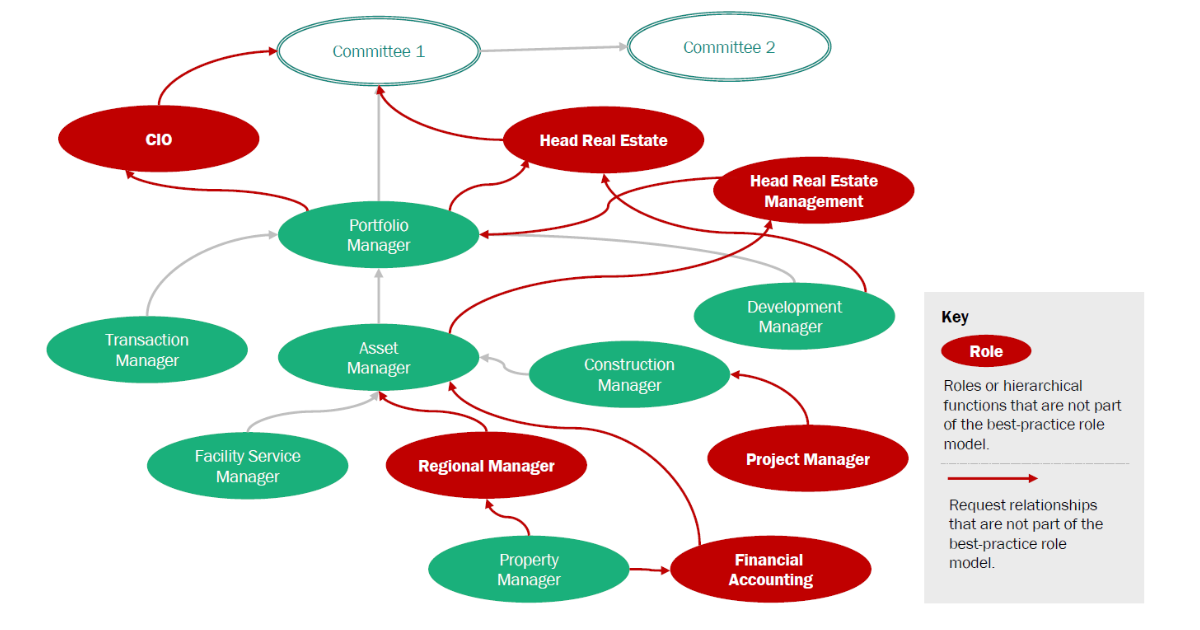
The following role model, which has evolved over time in practice, illustrates a complex application and decision-making process that is organised primarily along hierarchical lines – rather than on the basis of specialist expertise. This results in lengthy processing times and makes the rationale behind decisions difficult to trace and audit.
Modern Real Estate Investment Management (REIM): Governance as a Value Driver
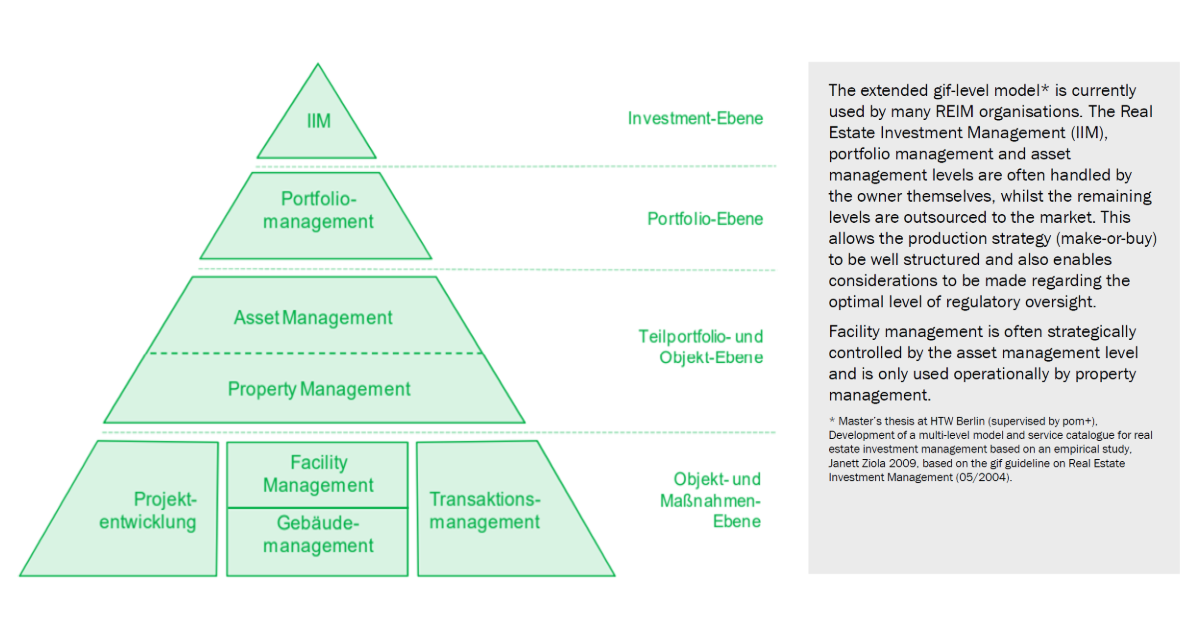
Professional real estate management clearly distinguishes between governance, functional accountability and operational execution. Modern REIM models – such as those based on the GIF standard (Society for Real Estate Research) and other best-practice frameworks – follow three fundamental principles, thereby ensuring governance, transparency and traceability:
- Decoupling formal hierarchy from functional governance: Decisions are based on defined roles and responsibilities – not on hierarchies that have evolved over time.
- Structured and transparent decision-making processes: standardised applications, defined KPIs, and clear rules on responsibilities and escalation.
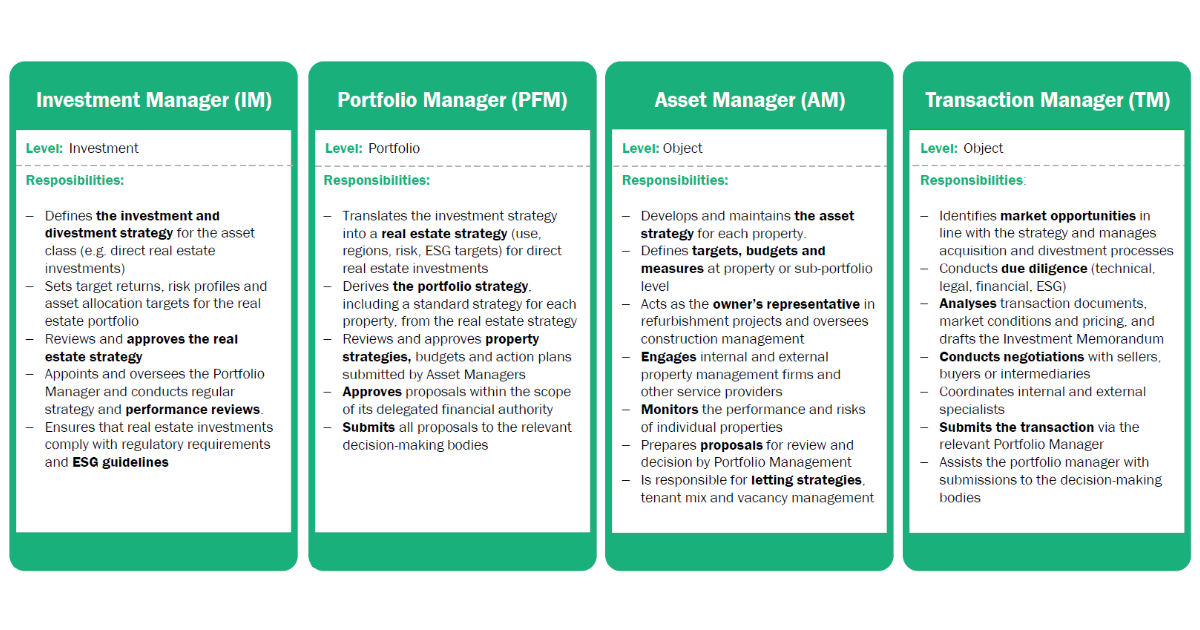
- Consistent, equivalent management levels throughout the entire lifecycle – from strategy to operational delivery.
- Strategy: Portfolio management (What to do?)
- Tactics: Asset management (How to implement?)
- Operations: Property management and administration (Who is responsible?)
This layered management structure has become widely established and forms an important prerequisite for transparent, audit-proof and sustainable property management.
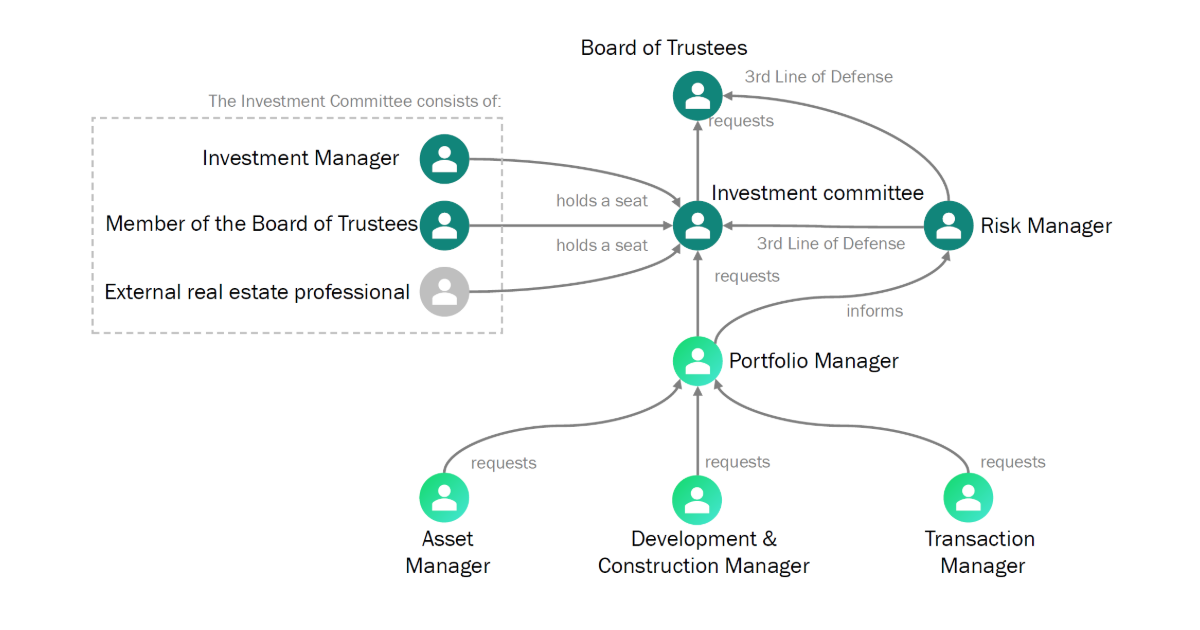
The governance model is based on the Swiss Code of Corporate Governance (OR) and the Swiss Federal Act on Occupational Retirement, Survivors’ and Disability Pension Plans (BVG), and supports the professional, transparent and audit-compliant management of real estate investments. Ultimate legal responsibility always remains with the Foundation Board or the Board of Directors.
Contact
Do you have any governance-related questions regarding direct real estate investments — for example on role and committee structures, responsibilities, decision-making processes, KPIs or interfaces with external service providers? We would be happy to assist you, drawing on our experience with governance and organisational projects in the REIM sector, or by conducting a concise assessment of your current situation.
We look forward to hearing from you.